


Daventry Hill School

Writing & Handwriting
At our school, handwriting is taught explicitly and progressively as appropriate. Our approach is designed to develop fluency, automaticity, and confidence in written communication. The aim is for all students to form clear, legible letters to support functional writing in everyday contexts by promoting the strong connection between physical development and writing.
Foundations for Handwriting
Handwriting readiness is closely linked to a child’s physical, neurological, and motor development. Before formal letter formation begins, pupils need to develop:
- Gross motor control
- Shoulder stability
- Core strength
- Fine motor coordination
The small bones and muscles of the hand continue to develop throughout early childhood. Many children are not ready for consistent letter formation until around 5–6 years of age.
Developing Skills in the Right Order
We recognise that writing is both a cognitive and a physical process. Before children can effectively hold tools, control marks, and form letters, they must build strong physical foundations. Students are therefore supported to develop:
- Core strength and posture
- Shoulder and arm stability
- Hand and finger control
- Hand–eye coordination
- Spatial awareness
- Bilateral coordination (using both sides of the body together)
Supporting Individual Development
Hand dominance (left- or right-handedness) is allowed to develop naturally and is never forced, as this supports efficient motor planning. We use our development ladders to observe and support this process carefully.
Teaching is thoughtfully adapted to meet the needs of all students through:
- High-quality modelling
- Repetition and practice
- Multisensory approaches
- Adaptive resources
- Appropriate physical support
Building Fluency and Confidence
We teach a consistent handwriting style across the school to reduce cognitive load and promote automaticity. Research shows that fluent handwriting develops most effectively through repeated, multisensory practice, movement-based learning, and explicit modelling, rather than through premature formal writing demands.
Squiggle Whilst You Wiggle - Developing Gross Motor Skills
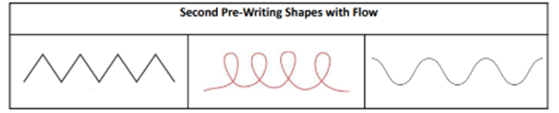
We begin our handwriting journey by focusing on Physical Development and Gross Motor skills. We use a Gross Motor writing intervention: “Squiggle Whilst You Wiggle”. It is an early mark-making and movement programme designed to develop the gross motor, fine motor and pre-writing skills needed for handwriting. It combines music, movement, large-scale patterns and sensory exploration to support physical development and early writing readiness. Its focus on physical development, patterns and directional movement supports progress onto small movements and fine motor skills; ‘large movements before small movements’.
We also encourage development of Gross Motor Skills through physical literacy and opportunities for movement. Through opportunities such as crawling, walking, running, accessing gym equipment, sensory circuits, movement breaks, big movements, yoga and soft play.
Developing Fine Motor Skills
Alongside Gross Motor development we also work on Fine Motor Skills.
These involve the coordination of small muscles in the hands and fingers to perform tasks that require precision and dexterity. These skills are essential for various daily activities, including writing, feeding oneself, buttoning clothing, using utensils, and manipulating small objects.
We link fine motor skills to writing readiness, this might look like:
- using one-handed tools
- manipulating small objects
- developing pincer grip
- using scissors
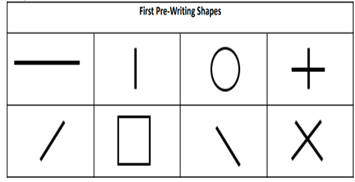
- drawing lines and circles (pre-writing shapes)
Therefore, we offer fine motor activities such as:
- Tracing lines and shapes;
- Play with tweezers;
- Tear paper;
- Practice strokes in sensory trays;
- Draw on vertical surfaces;
- Playdough;
- Droppers/pipettes or squirt bottles;
- Crayons/chalk/colouring;
- Threading; Lacing; Sewing;
- Buttons and in-hand manipulation;
- Building;
- Drawing;
- Peel and place stickers;
- Pencil paths;
- Drawing/mark making in sensory materials.
Dough Disco - A Fine Motor Programme
To support fine motor skill development we use “Dough Disco”.
Dough Disco is a fun, multisensory fine motor programme that combines music, rhythm and repetitive hand movements using playdough.
Students strengthen the small muscles of the hands and fingers through squeezing, rolling, pinching and pressing actions performed in time to music.
The programme supports finger isolation, bilateral coordination, hand strength and pencil control, helping to build the physical foundations needed for handwriting.
Write from the Start - an intervention
For some students, who have some specific fine motor skill difficulties, we offer ‘Write from the Start’.
Based on holistic principles, this programme develops the muscles of the hand - so that children gain the necessary control to produce letter forms – alongside the perceptual skills required to orientate and organise letters and words.
Read, Write Inc handwriting
For those who are ready for formal handwriting, we use the Read Write Inc handwriting scheme.
There are 3 stages of handwriting in the scheme. We consistently use mnemonics for our younger students but adapt their use when delivering to our older students, particularly in our secondary department.
Stage 1a
During Stage 1, children learn correct letter formation using the same picture mnemonics they have already learnt in the Set 1 sound lessons.
These letters are taught in handwriting groups:
- ‘Around’ letters: c a o d g q
- ‘Down’ letters: l t b p k h i j m n r u y
- ‘Curly’ letters: e f s
- ‘Zig-zag’ letters: v w z x.
During these early stages, children write on plain paper.
Stage 1b:
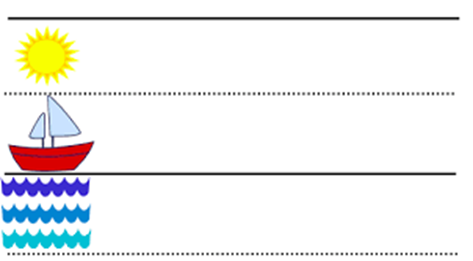
Once children can form the letters correctly, they learn how to place the letters on the line and of relative size. Children are encouraged to continue using the picture mnemonics to help children to visualise the size and placement.
The Read Write Inc programme uses the boat and waterline as a guide for children to learn to form their letters within size and orientation.
Stage 2
During Stage 2, children are now taught that they are going to use new characters to help them develop a grown-up style of writing that will lead to joined-up writing. New pictures will help them to visualise the new shapes.
The children are introduced to the formation family: six sisters, two uncles and their two pets.
Stage 3
The final handwriting stage within Read Write Inc, introduces the children to two joins:
- The arm join (diagonal)
- The washing line join (horizontal)
We would encourage our students to complete Stage 3 if they are showing readiness or functional need for joined cursive script.
Transcription
We continue to model and demonstrate handwriting through lessons.
We have a transcription assessment framework and use this alongside check lists in English lessons.
We are mindful of cognitive load to ensure there is a balance of effective transcription but also time to develop stamina, remember ideas and sentence construction.
In our environments you will see a mixture of handwritten and printed labels (alongside symbols), drawn story maps on washing lines and adult modelled WAGOLLs (What A Good One Looks Like) used in lessons.